Sargassum Seaweed Report for St. John, USVI (June 2026)
While 2026 is becoming a record year for Sargassum in the Virgin Islands — where it peaks in June and July — the beautiful beaches to which we charter many of our private trips have not been impacted, including the north shore beaches. The biggest deposits of Sargassum are found on easterly-facing bays and beaches where tourists generally don’t visit.
Overall, the best beaches on St. John are still fine to visit as of the time of this update (June 15, 2026).

Sargassum at an easterly facing bay in St. Thomas
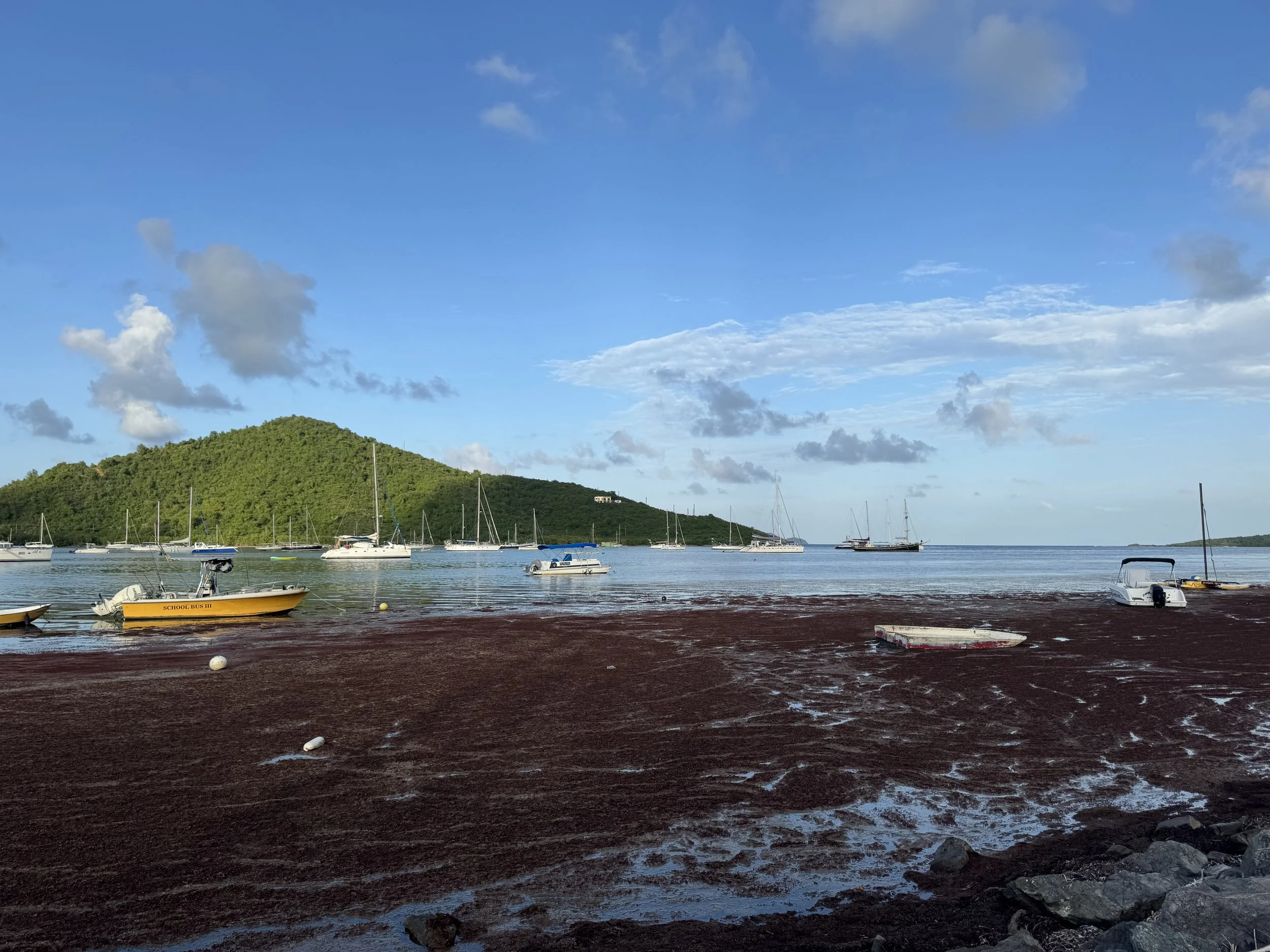
Sargassum floating in Coral Bay Harbor, St. John USVI
Sargassum Tracker Report For St. John USVI (As of June, 2026)
For anyone who wants to know where the Sargassum is around St. John USVI, we have been monitoring it from the ground and have a lot of good news to share.
Although the USVI is experiencing a heavy Sargassum season right now, it isn’t impacted nearly as badly as other beach destinations, like Fort Lauderdale, Florida. It’s worth noting that Sargassum is just passing through this area of the Caribbean for the most part, and isn’t making St. John or St. Thomas its final destination.
Sargassum is mainly affecting the eastern shorelines, on St. John, which include: Friis Bay, Haulover and John’s Folly. Most of these areas are not visited by tourists. Coral Bay is also affected, but as a boating harbor there are no beaches that tourists would visit here. Popular tourist destination beaches such as Maho Bay, Trunk Bay, Cinnamon Bay, and Honeymoon are not affected by the Sargassum.
| Area | Impact Level | Notes |
|---|---|---|
| Friis Bay, Haulover, John's Folly (East Shore) | High | Areas affected by Sargassum; not commonly visited by tourists |
| Coral Bay Harbor | Moderate | Impacted by Sargassum; primarily a boating area with no tourist beaches |
| Maho Bay, Trunk Bay, Cinnamon Bay, Honeymoon Beach | None | Popular tourist beaches; currently unaffected by Sargassum |
| General Observation | Moderate to High | 2026 is on track to be a record sargassum year; amounts rose across nearly every monitored Atlantic and Caribbean region in May, and further increases are expected through June |
| Comparison with Lauderdale, Florida | Less Impacted | St. John and St. Thomas are experiencing lighter effects than destinations like Lauderdale, Florida, though major beaching events have been reported across the broader Caribbean this 2026 season |
Refer to this Caricoo Sargassum Tracker to see a satellite map of these large mats of seaweed floating around the Caribbean.
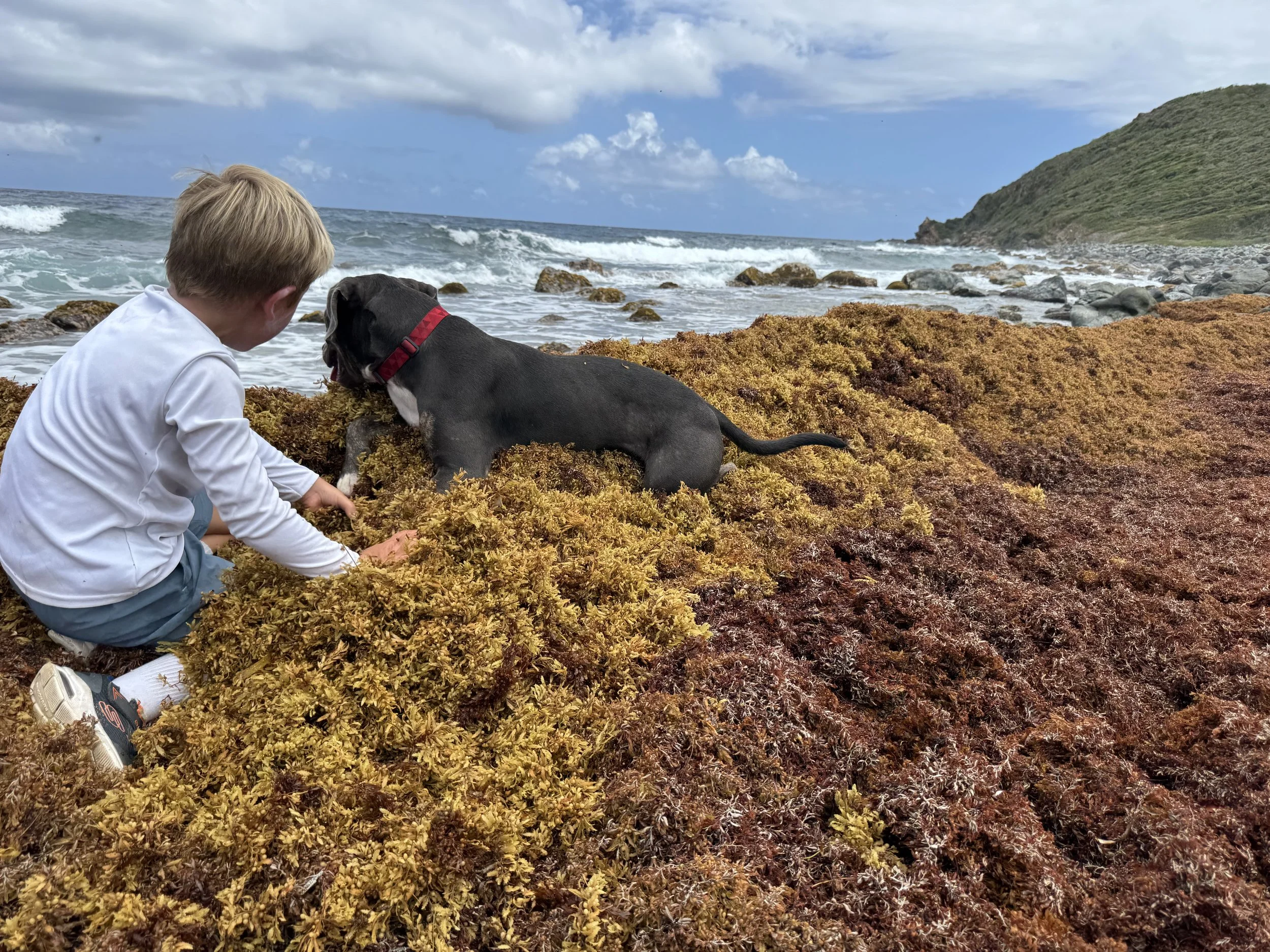
Piles of Sargassum in Drunk Bay St. John USVI - Image courtesy Island Roots Charters
When Is Sargassum Season In the Virgin Islands?
April through August is when Sargassum season generally occurs in the USVI / BVI.
What Is Sargassum?
Sargassum is a free-floating brown algae that thrives in warm, tropical, shallow ocean waters and around coral reefs. The Sargasso Sea in the Atlantic Ocean was named by Portuguese sailors in the 1400s, who encountered vast mats of the seaweed during their voyages.
The Journal of the First Voyage of Columbus is thought to be one of the first mentions of Sargassum in writing. As the expedition sailed through the Sargasso Sea, these words recorded the observation noting how prevalent Sargassum was, even back then: “At dawn they saw so much weed that the sea appeared to be covered with it, and it came from the west.”
Why Is Sargassum a Problem?
Sargassum has always been in the Caribbean since it is native to the Atlantic. That means it is not technically considered an invasive, but since 2011 its explosive growth has gotten out of control. The exact cause is unknown, but scientists theorize that warming ocean temperatures and industrial fertilizer runoff may be to blame. According to the University of South Florida, 2026 is on track to potentially be a record sargassum year by summer, with amounts rising across nearly every monitored Atlantic and Caribbean region.
Sargassum isn’t generally considered dangerous to humans, but one of the reasons it is perceived as a bigger problem than ever before is because as it decomposes it releases a gas (hydrogen sulfide) that smells like rotten eggs. That wouldn’t be so bad if this algae lived in places people didn’t like to visit, but it so happens it loves tropical beaches just as much as humans.
The second reason, and far more alarming than compelling tourists to hold their noses, is that it may be contributing to climate change which poses a risk to our entire planet. This is because Sargassum releases methane, a powerful greenhouse gas, which ironically perpetuates the vicious cycle that causes more record blooms.
And finally, when Sargassum arrives in huge piles alongside the picturesque beaches of the Caribbean, it becomes a waste management issue that local businesses and governments address by bringing in workers and heavy equipment to dispose of the biomass in landfills, or move it to areas where it won’t be noticed. Because Sargassum may contain contaminants, improper management can lead to groundwater pollution and trigger a chain reaction of ecological problems.
As a Natural Solution, Can’t Sargassum Be Eaten Or Used?
Sargassum is purportedly edible, and has historically been used in Chinese medicine, teas, and as an additive in livestock feed. So, why can’t the Sargassum problem be fixed by eating it, exporting it to the Chinese, or by feeding the local livestock with it? Locals, after all, are tackling the invasive Lionfish problem in the USVI by encouraging people to eat as many of them as they can.
The reason why sargassum should not be eaten is that it contains high amounts of arsenic, pollutants, and pesticides, so while local chefs might enjoy trying to make the best of a bad situation, it isn’t safe to try to eat this smelly invader.
Will Sargassum Hurt Local Wildlife Like Sea Turtles?
Sargassum can on one hand offer refuge for the wildlife in the Virgin Islands like sea turtles that can use it to hide from predators, but new studies show that in excess thick piles of seaweed can block hatchlings from reaching the ocean.
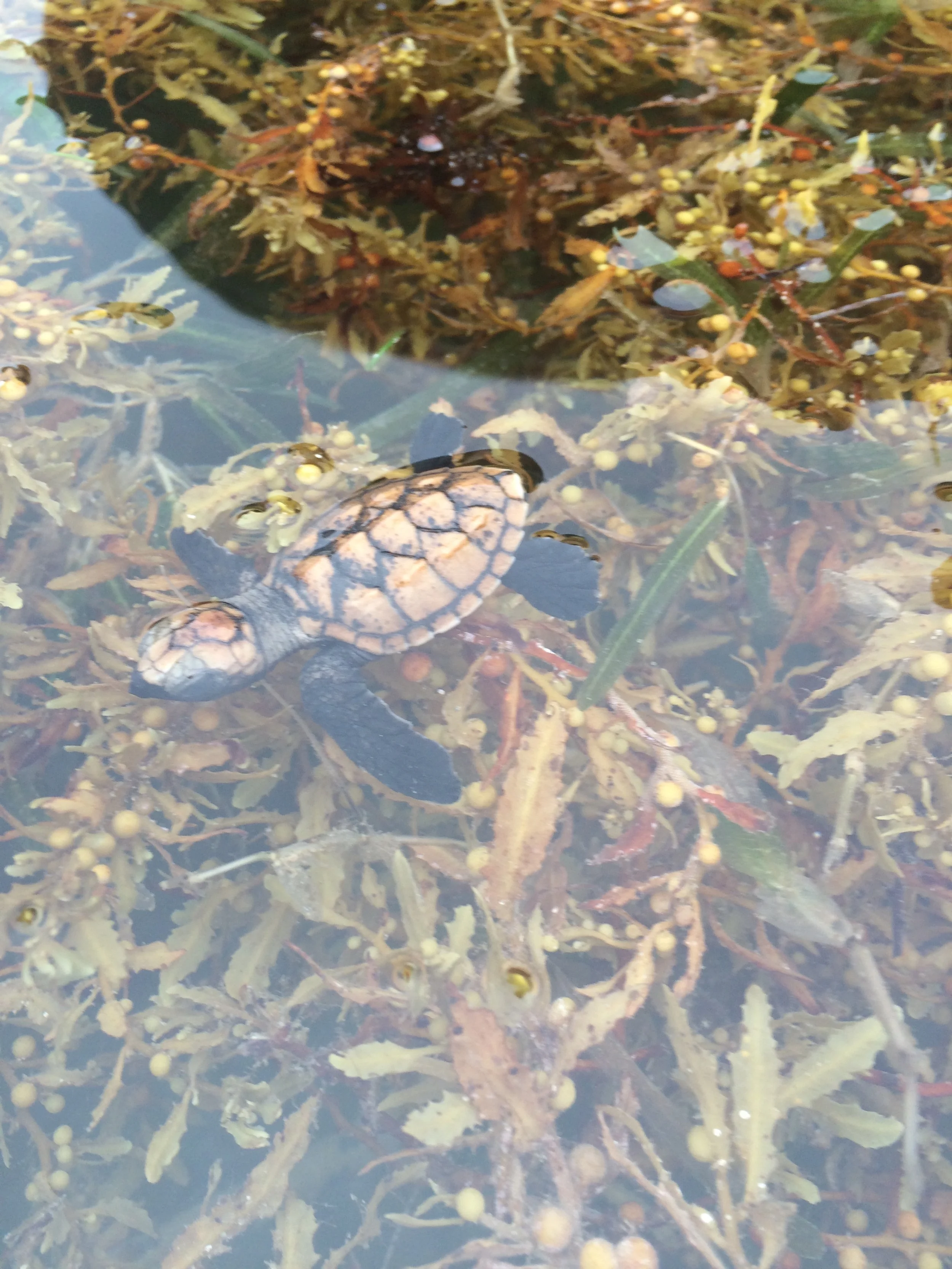
USVI Baby Turtle In Sargassum - Image courtesy Island Roots Charters
Should I Cancel My Trip To The Virgin Islands Because Of Sargassum?
There is no need to cancel a vacation because of Sargassum blooms, especially in this case to the USVI, because the best beaches and other tourist hot spots are largely unaffected, as of June, 2026.