Saharan Dust In The Virgin Islands — Brings Beautiful Sunsets
Saharan dust settles over the Virgin Islands every spring. This is nothing new. For eons, massive clouds of North African desert dust have sailed westwards on the trade winds sweeping from Africa into the Caribbean and beyond.
These established global dust systems are composed of fine mineral particles which are lifted from the Sahara Desert by the warm updrafts and then carried thousands of miles westward across the Atlantic to the U.S. and British Virgin Islands. The months that Saharan dust is present here are between May and October of each year.
As of late May 2026, meteorologist Matt Devitt has confirmed that there are large plumes already moving toward the Caribbean and will continue arriving well into June. He also notes that this is nothing new, just a phenomenon we can now detect thanks to modern technology. Devitt also calls out the positive benefits of Saharan dust right away: “The dust can weaken or suppress tropical activity in impacted areas and bring vibrant sunrises and sunsets too!” Fewer storms and more beautiful sunsets, who can resist!
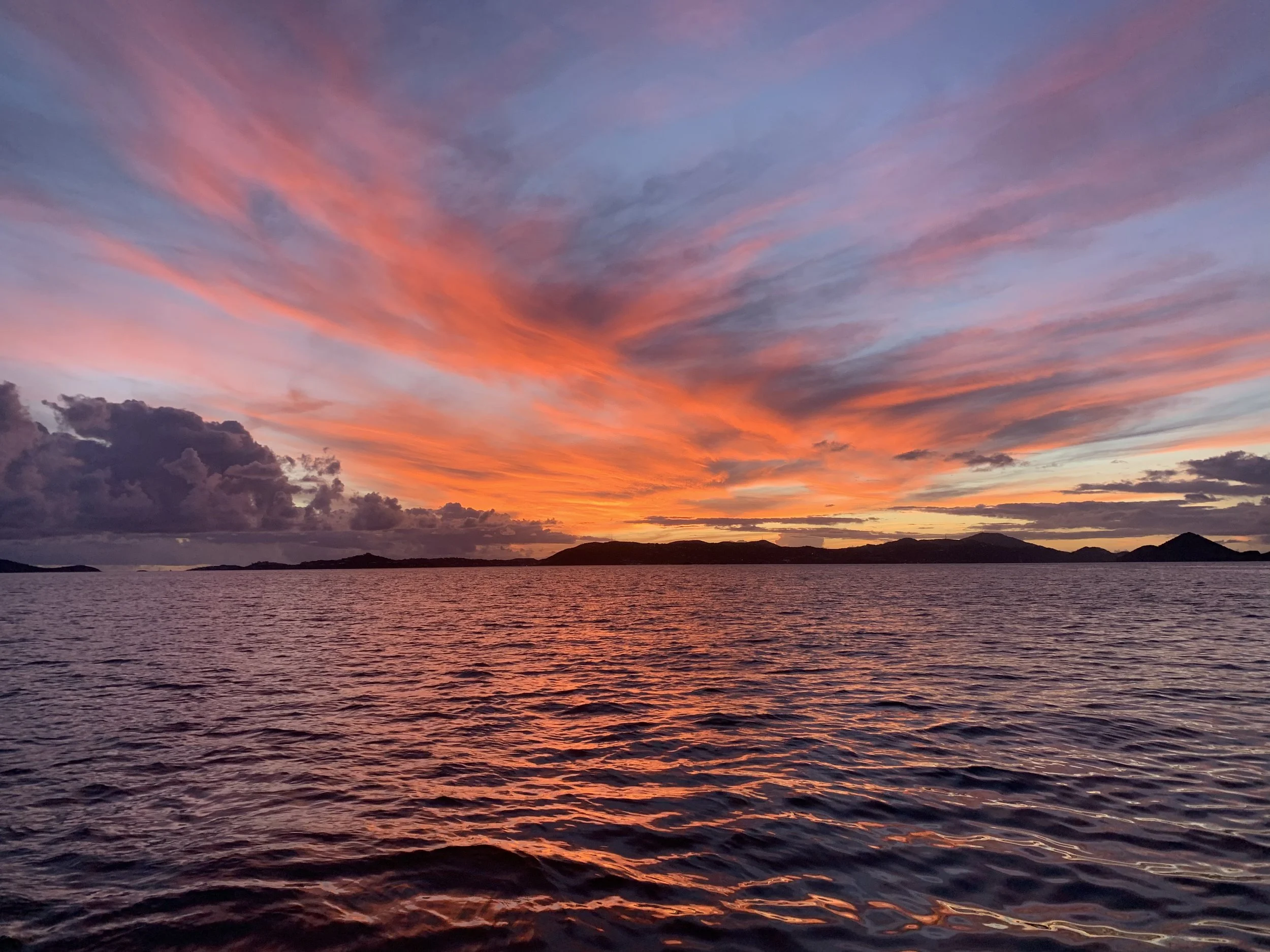
Saharan dust sunsets are common in Spring / Summer in St. John, USVI — Image Credit: Island Roots Charters
Sunsets and Fewer Hurricanes
Seriously, Saharan dust can bring on some of the most spectacular sunsets you will ever see anywhere in the world. That’s because the fine mineral particles scatter sunlight in ways that deepen the colors of the average sunset into deeper pinks, oranges, and reds that look almost surreal. That’s when you start wondering if you’re dreaming — make sure to snap out of it long enough to take what might be your best shot of the whole trip.
Even more practical, this desert dust suppresses hurricane formation because its dry, stable air mass inhibits the warm, moist, rotating conditions that tropical storms need to bloom into full scale nightmare winds and floods we humans cancel expensive vacations to avoid. Colorado State University's forecasting organization includes Saharan dust levels as a variable in their hurricane outlooks.
For those like us who live here, the reality is that a few hazy horizons and itchy eyes are an acceptable tradeoff for a muted hurricane season and better sunsets.
What Saharan Dust Is
According to NOAA, the Saharan Air Layer, the technical name for this natural dust mass phenomenon, moves across the tropical Atlantic in waves every three to five days, in clouds roughly two miles thick. Activity typically begins in late spring, intensifies through June, and peaks from late June through mid-August before subsiding. By the time the plumes reach the end of their Atlantic crossing, the Virgin Islands is right in their path.
How Long Saharan Dust Lasts
Even though the Saharan dust can occur anytime throughout the spring and summer, it arrives unpredictably in waves rather than descending and locking in permanently over a strict window of time. For example, a dust event can last anywhere from two to five days before clearer air returns. Sometimes — especially in June and July — one plume can follow another with brief windows of clear air in between, making it feel like it has lasted for weeks.
Causes of Saharan Dust
Counterintuitively, around 80% of Saharan dust in summer is caused by thunderstorms, not the haboob-like sandstorms we imagine blowing the dry desert sand so hard that it spreads worldwide. It’s nothing like this. Over the Sahara, the air is so dry that rain falling from high altitude storm clouds evaporates before it ever hits the ground, which causes the air temperature to drop. That cooler air slams down on the desert floor like a massive, invisible hand bringing up immense quantities of dust. Scientists call this "cold pool outflow."
What causes the Saharan dust to be bad one year or not in the Virgin Islands depends on whether the drought conditions in North Africa are more severe. Bad droughts mean more of the desert surface is exposed and dry, giving those storm outflows more loose sand to lift. The strength of the trade winds is another seasonal factor that determines whether the Virgin Islands get hit with dust clouds, or how bad the dust will be.
2026 Saharan Dust Virgin Islands Forecast
The 2026 forecast predicts an active dust season in the USVI and BVI, running through at least mid-June. Some summers are heavier than others depending on atmospheric patterns over the Sahara.
Rain Can Wash Away Saharan Dust
Rain clears dust from the air, so a good afternoon shower on St. John for instance can help. It’s common for brief tropical showers to roll through here in the afternoons, which make for the perfect natural counter to this dust.
The 2026 Virgin Islands Saharan Dust Advisory
According to the VIDOH ( VI Department of Health) advisory on Saharan dust (doh.vi.gov), the dust can irritate the eyes, nose, and throat. For most healthy people, exposure during a charter trip is unlikely to cause serious issues. But the VIDOH specifically notes higher risk for those with preexisting medical conditions, such as asthma or heart disease. If any of this is relevant for you or you have special concerns, don’t take our (or the internet’s) word for it — check with your doctor — before scheduling your trip.
For most guests, the practical experience is usually a mild response some may not even notice, like red, itchy eyes or a scratchy throat. On the water it’s best to stay hydrated and wear sunglasses when there’s Saharan dust in the air.