Captain Enzo’s Field Guide to Reading the Caribbean Sea: Currents, Stars, and Wildlife of St. John, USVI
There is an art to reading the ocean without the use of a compass, or technology devices. It requires fully activating the five senses into a form of multi-directional antennae to tune into nature’s perpetual signal output. In the wild blue yonder, stars become compasses, the Moon a tidal chart and guiding light to see by, ripples in water a shallow hazard alarm, and the scent of a particular mustiness a sign that severe weather is approaching.
Sometimes a sixth sense or wisdom develops after years of navigating the sea by nature, as we see in the tales of sea captains who simply cannot lose their way — no matter how dark the night, how thick the fog, or how wild the storm. It’s as if some natural law protects them, the same one that keeps cats from landing on their backs when they fall from a limb (or these days, the back of a couch). It’s how the pirate captains of the Caribbean once knew every hidden cove and secret inlet, every sandbar and buried piece of eight.
At Islands Roots Charters, our captains have that same sea-born instinct.
Take Captain Enzo, for example. He’s one of those rare few who reads the ocean currents, senses the wind shifts, and somehow knows the best places to go in the Virgin Islands.
Here’s what one guest, Stefanie Culler, shared in a five star Google review after her family’s day on the water:
“Enzo was an amazing captain with endless experience about water currents and weather. He knew the exact times when the currents would change. He knew the best spots to snorkel and was a great teacher throughout the day. He kept a watchful eye on everyone and was ready at any moment if anyone got tired swimming. Thank you so much Enzo for your hospitality and kind spirit. We really enjoyed every moment!
On Night Navigation (Moon, Stars, Darkness at Sea)
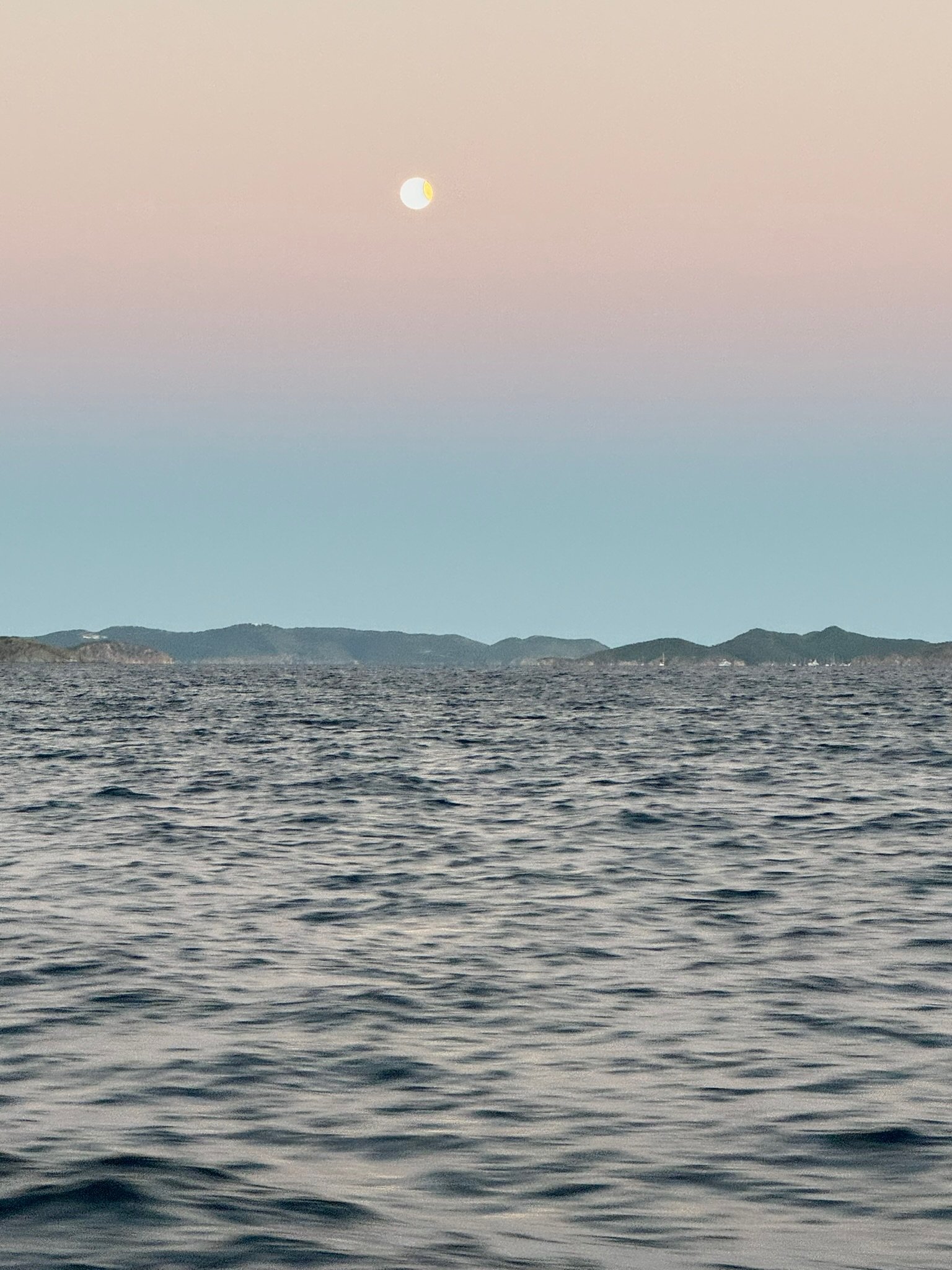
A full moon rising over Coral Bay, St. John USVI, means tides and currents will be strong / Image credit: Island Roots Charters
Question: What does the Moon tell you about the ocean?
Captain Enzo: The moon is the most significant factor affecting tides and tidal currents. For a simple guide we tend to have our largest tidal changes and strongest currents during the full and new moon phases. We then observe a lesser tidal fluctuation along with weaker currents during the quarter/“half” moon phases.
Q: How does moonlight affect the way waves and surface patterns appear?
Captain Enzo: Operating at night during a full moon is significantly easier/safer than operating during the new moon. When skies are clear of clouds and dust the light from the full moon is able to illuminate all of the little lightless islands around and even the water surface. With the water surface illuminated you are able to tell with relative ease when you enter certain current channels and at times you can even see the ocean floor from the boat. As long as you posses a good working knowledge of the area it may actually be easier/safer to operate with no gps and minimal electronics illuminated as to not impact your night vision.
Q: What if there is no Moon?
Captain Enzo: This can be difficult to impossible during a new moon since there is no light in the sky. During the full moon however you can often see all the clouds around and if you lose all moonlight because of dense cloud cover it may be a good idea to head to a safe anchorage. If the clouds are combined with a sharp increase in wind strength it just adds to the importance of finding protected waters.
On Currents & Wind (Surface Clues, Ripples, Swells)
Q: What do different ripples or small wavelets tell you about hidden hazards and or current direction?
Captain Enzo: Breaking waves on the water generally indicates a shallow hazard. If there is no swell or wind that day but there is current you can still observe shallow features. At that time you will see turbulence disturbing the surface as current forces water over and around said hazard.
To tell the current direction you observe which side of said hazard has calm water and which side the water looks more rough. Most of the time the water is flowing from the calm side to the rough side. As the water flows over and around a subsurface structure it becomes turbulent and agitates the surface. This turbulence can create eddy lines that peel away from the shallowest point of the structure. This is all much easier to observe if there is no wind chop in the area.
Q: How can you spot wind approaching just by watching the water’s surface?
Captain Enzo: You can see micro ripples on the surface of the water that indicate a localized gust (sharp increase in wind). These ripples appear as dark patches that travel on the water's surface. If the winds are steady then there will be no observable dark patches as the ripples will be all the same. The presence of darker patches indicate gusty conditions.
Q: What does it mean when waves cross each other from two directions in the VI?
Captain Enzo: Most of the time this indicates that wakes from different vessels are interacting with each other or the prevailing wind swell direction. You can also observe chaotic sea states where steep cliffs enter the ocean.
Q: How do you tell the difference between a tidal current and a wind-driven current?
Captain Enzo: As long as there is some wind there will be a bit of surface current moving in the same direction the wind is blowing at that time. The intensity of, and how deep that wind current affects the water column is a direct product of the wind speed that day.
Tidal currents on the other hand are dictated by two factors, the moon phase and the local bathymetry (structure of the ocean floor). The moon, for the most part, affects the intensity of a tidal current as well as when it will flow in a particular direction (changes by about an hour each day). Most places around the Virgin Islands experience two directions in which the current will flow throughout the day. One direction characterizes the incoming tide while the other direction characterizes the outgoing tide. It is also important to note that the tidal current will be affecting the entire water column.
Without getting in the water the simplest way to gage a tidal current as opposed to a wind driven current is to observe an object that floats just under the waters surface. Since it is below the surface the wind will have minimal effect on the object's movement. People often make the mistake of thinking that the direction a boat is drifting indicates what the tidal current is doing. In some cases you can get it right that way (mostly when there is little to no wind). However you must realize that the wind will always have a greater relative effect on a boat's drift because most of the boat is out of the water.
Q: What changes in water color or clarity hint at shifting tides or currents?
Captain Enzo: There is often one tidal current (incoming or outgoing) that brings in clearer water than the other. Which it will be is not easily predicted as there are multiple factors constantly affecting water clarity. Understanding swell direction/intensity, prevailing winds, and runoff/ sources of pollution are key in determining where the “dirty” will come from.
On Animals (Birds, Fish, Sea Life as Clues To Weather at Sea )
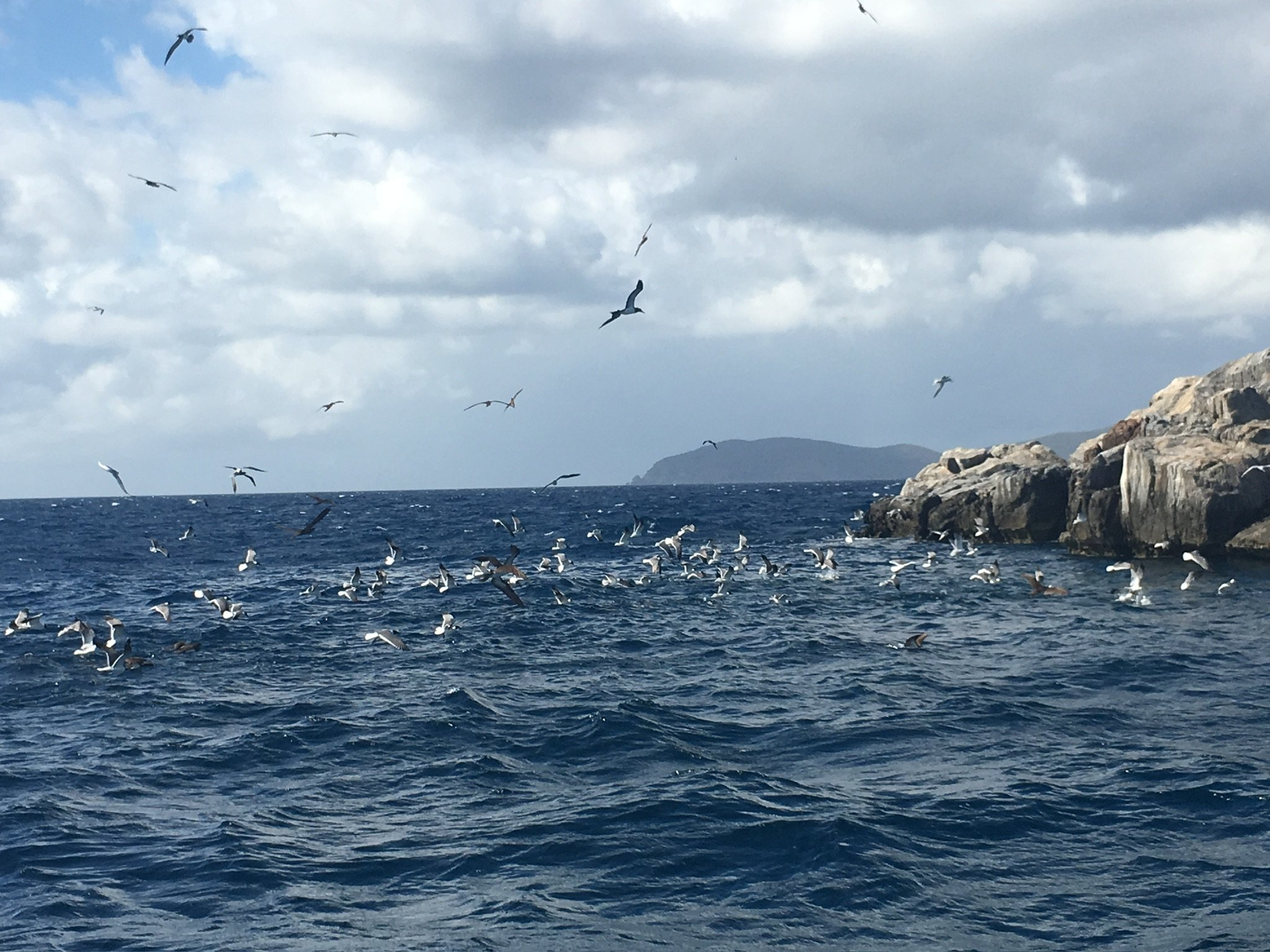
Numerous seabirds circling and landing in the sea indicate bait fish in the area / Image credit: Island Roots Charters
Q: What do seabird behaviors (pelicans diving, frigate birds soaring, terns darting) reveal about fish or weather?
Captain Enzo: Birds diving is a tell-tale sign that there is baitfish around. However more often than not it also is an indicator of larger predatory fish being present as well. This is because most sea birds are reliant on these predatory fish to force the baitfish to school densely near the surface making them easier targets.
Q: Have you ever predicted storms or shifts in weather from fish behavior?
Captain Enzo: Unless you have access to satellite trackers on certain fish species to tell when they leave shallow water it is easiest to watch bird behavior. Minor storms won’t cause much of a change in behavior. At the time birds fly away as a major storm is approaching is when you should be ready for extremely foul weather.
Q: What does it mean when fish are jumping in unusual patterns or directions
Captain Enzo: Most commonly it is a result of them attempting to flee larger predatory fish. In isolated waters, like bays or estuaries, it could be a sign of hypoxic (low oxygen) conditions or heavy pollution. Some fish like tarpon can be observed “breathing” air when the water becomes hypoxic.
Q: Do turtles, dolphins, or other marine life give clues about currents or hidden features?
Captain Enzo: Bait fishes and juvenile fishes that feed on plankton will distribute themselves around a specific structure almost solely depending on current flow. That said you can use the direction of the current to predict where most of the fish action will be over a reef. It is more often easier to read the current flow first. In some cases, especially if the water is deep and you have sonar equipment, you could make inferences on current flow by observing where the fish are aggregating around a specific structure.
Q: Do land animals, roosters, frogs, insects, give reliable signs of incoming rain?
Captain Enzo: In tropical regions most insects and amphibians will become more active during periods of consistent rainfall.
On Day Sky & Sun (Clouds, Light, Rain, Orientation)
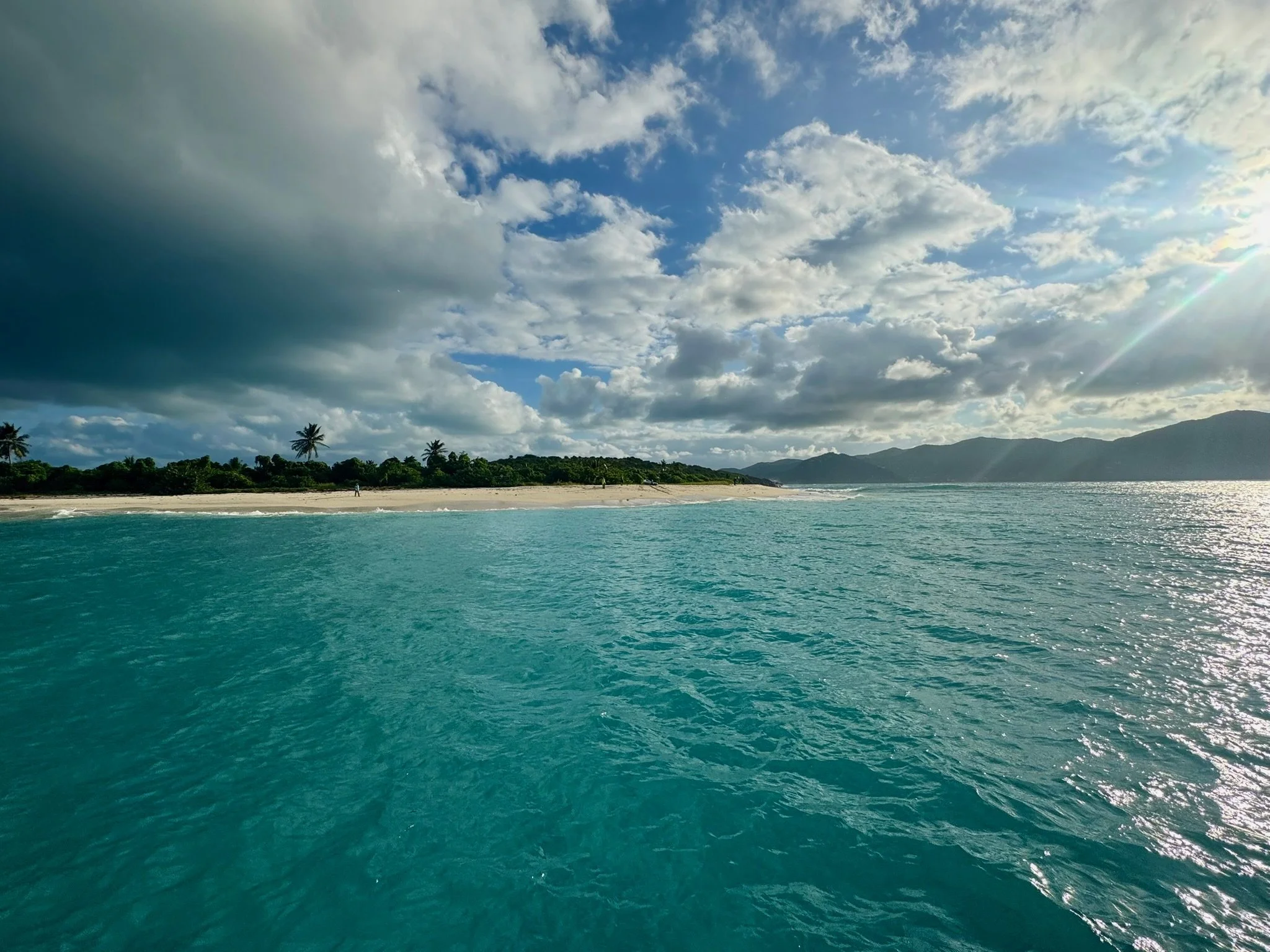
Clouds like these means could be some weather moving in / Image credit: Island Roots Charters
Q: Which clouds are the most important to watch in the VI for predicting weather?
Captain Enzo: Cumulus clouds (the big fluffy ones) are the best tell-tale sign of bad weather. The largest of which are the cumulonimbus class. These clouds often result in thunderstorms as well as copious precipitation.
Q: Can the colors of sunrise or sunset really forecast the next day’s weather?
Captain Enzo: There is an old sailors proverb for this; “red skies in the morning sailors take warning, red skies at night sailors delight.”
Q: How do you use the sun’s position to navigate without a compass?
Captain Enzo: The sun rises in the east and sets in the west. It is easiest to get a good bearing using the sun while it is near the horizon, especially in lower latitudes like the VI.
Q: How do light and water color changes, turquoise, deep blue, silvery, hint at what’s happening with weather or depth?
Captain Enzo: The VI often has really clear water allowing most subsurface hazards to be relatively easy to spot. That said there are a few color characteristics of the water to be aware of in order to avoid these hazards. In standard conditions the dark blue water around the islands is deep, generally between 50-100 ft.’. Approaching the turquoise water can be confusing to those used to poor water quality. That turquoise color just means the bottom is mostly sand and can be anywhere from 30’ to under 10’. For the most part it is still safe to navigate, just proceed with caution in these areas and keep an eye out for reefs and rocks. Sea grass beds can appear as a really dark greenish color and because of this you cannot always assume dark water means deep, especially if you are near shore or inside a bay. Avoid any water that is a vivid olive green color, this characterizes shallow rock and reef. This is especially dangerous if you observe any breaking waves or disturbed water over that area.
Other factors that affect overall water clarity are important to consider as well. In the winter time we tend to have a tad bit more algae in the water making it slightly more greenish across the board. If we are experiencing a big ground swell then the water often becomes a very milky blue green color. After heavy rainfall the water nearshore, especially bays, can become a muddy brown color. A good rule of thumb for the Caribbean is to be very cautious and reference your charts/local knowledge if the water is anything but the classic vibrant blues we are accustomed to.
On Smells (The Sea, Wind, and Weather Clues)
Q: Can you smell the difference between open water and being close to land? Can you describe the smell if so?
Captain Enzo: When talking about scents it is important to remember that the human sense of smell has developed to be more keen in noticing changes in ambient scents rather than a persisting scent. This is why people often become smell blind to their familiar surroundings.
The tropical ocean in general will have a more humid salty smell to it. There are many smells that can accompany approaching land, all depending on what type of human or animal activities that are present.
Q: How do the scents of mangroves, seagrass, or coral reefs change with wind and tide?
Captain Enzo: Winds are simply causing the molecules responsible for a specific scent to travel in the air. The speed and direction a scent will travel is directly affected by wind speed and direction. Heavy winds cause scents to travel further but also become more dispersed. Light winds won’t allow the scent to travel as far but can cause it to be more concentrated to a location, becoming very pungent if the area is stagnant.
Tides simply cause certain odor sources to oscillate between being exposed/dry or covered/submerged. Low tides often result in more rotten smells due to the exposure of rotting vegetation and low oxygen soils are exposed to the air.
Q: Are there smells that warn you of rain or storms approaching?
Captain Enzo: In cases of severe weather the ambient air may exhibit a slight mustiness. Some weather can also cause a drop in ambient air pressure, enough to affect your ears.
Q: Do different fish or schools of fish carry a smell that tells you they’re nearby?
Captain Enzo: Sometimes when certain baitfish are concentrated in the bays you can observe that classic oily fish smell. In terms of being able to identify different species that is near impossible. It can even be hard to tell the difference between rotting algae and fish.
Q: How does the smell of the sea itself change between calm, windy, or stormy conditions?
Captain Enzo: The salty smell of the air can become very intense near the shoreline during periods of heavy winds and swell.